Press Release
Orbital Eye User Conference highlights industry shift towards continuous satellite-powered monitoring
International infrastructure leaders demonstrate how satellite-powered monitoring is becoming the new operational standard for protecting critical infrastructure
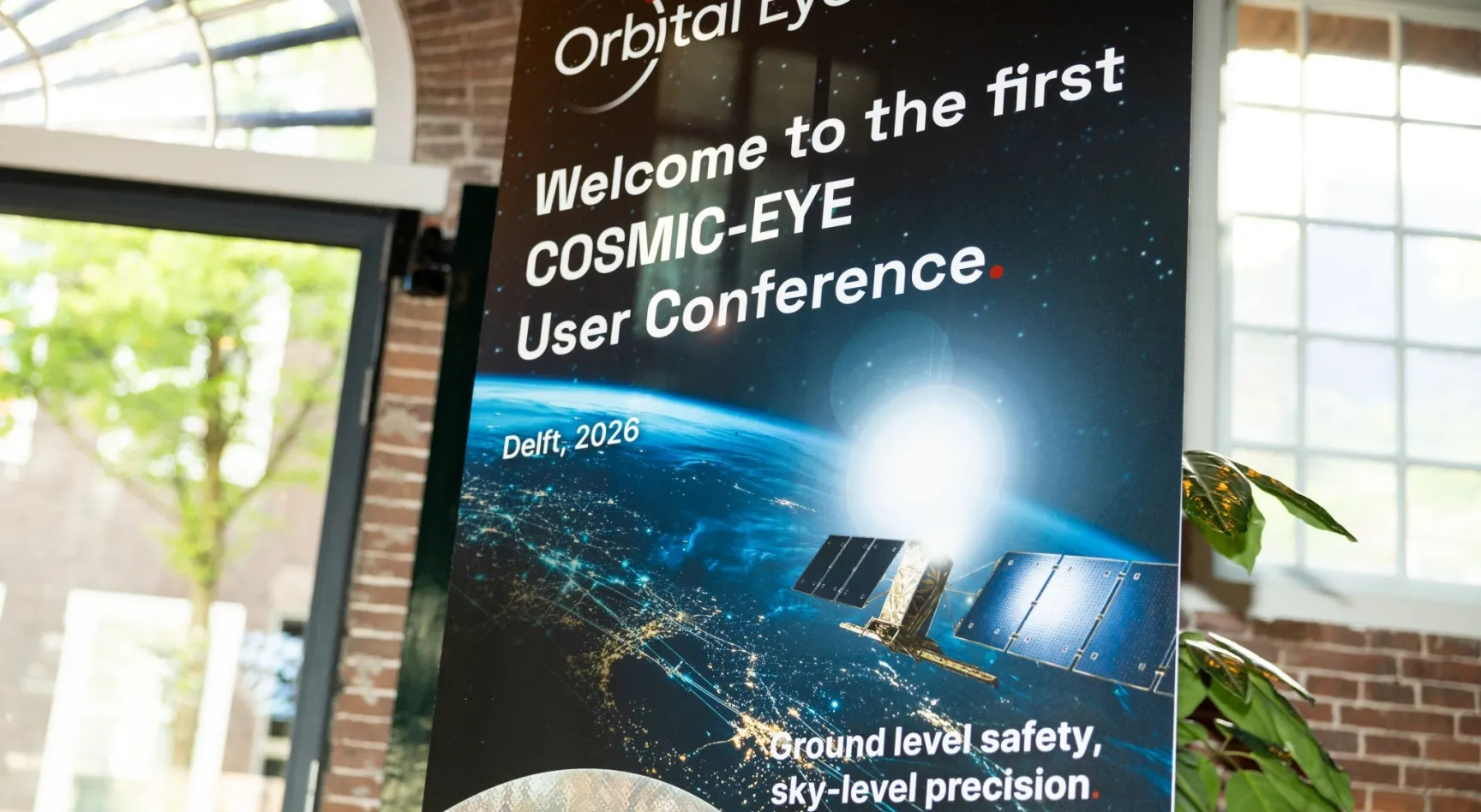
Delft, Netherlands — July 3, 2026 — Satellite-powered monitoring is rapidly becoming the new operational standard for protecting critical infrastructure as operators respond to growing resilience requirements, increasing pressure on essential infrastructure networks and a changing geopolitical landscape. Customer case studies, international experts and infrastructure operators from Europe and North America highlighted this accelerating industry transition during the first COSMIC-EYE User Conference in Delft.
More than 40 industry professionals from over 10 countries attended the conference, bringing together infrastructure operators, technology partners, industry experts and industry associations, including representatives from Natran, RTE, LSNed, Gascade, Shell, and Slovnaft. Together, they shared practical experiences demonstrating how satellite-powered monitoring is increasingly moving from innovation programmes into day-to-day operational use.
From innovation to operational practice
Operational deployments presented by leading infrastructure operators illustrated that the industry has reached a turning point.
Driven by increasing demands for safety, operational efficiency, sustainability and regulatory compliance, infrastructure operators are fundamentally changing how they monitor their assets. Rather than relying primarily on periodic helicopter patrols and field inspections, organisations are increasingly implementing continuous satellite-powered monitoring to provide uninterrupted visibility across thousands of kilometres of critical infrastructure.
Recent operational deployments by Enagás in Spain, LSNed in the Netherlands and BHE GT&S in the United States demonstrate that this transition is no longer limited to pilot projects or technology evaluations. Instead, leading infrastructure operators are integrating satellite-powered monitoring into their operational processes to improve decision-making, detect risks earlier and reduce inspection costs.
Technology maturity is accelerating adoption
Customer case studies, operational deployments and expert presentations demonstrated that recent advances in satellite availability, artificial intelligence, cloud computing and multi-sensor data fusion have fundamentally changed the business case for infrastructure monitoring.
Satellite-powered monitoring has evolved into a reliable, scalable and cost-effective operational capability that complements, and in many situations partially replaces, traditional inspection methods. The discussion is therefore no longer whether satellite monitoring works, but how organisations can most effectively integrate continuous monitoring into their daily operations.
Growing resilience requirements are accelerating the transition
Customer discussions and expert presentations also highlighted a broader shift in the operating environment. As societies become increasingly dependent on critical infrastructure, including electricity networks, gas transmission systems and other essential assets, the consequences of outages or physical damage continue to grow. At the same time, heightened geopolitical tensions and the increasing vulnerability of critical infrastructure are prompting operators to strengthen their monitoring capabilities and improve situational awareness.
Together, these developments are accelerating the adoption of continuous satellite-powered monitoring as an essential component of modern infrastructure management.
Sharing operational experience
Operational experience formed the core of the programme, with over 20 infrastructure operators discussing how satellite-powered monitoring is being integrated into day-to-day asset management. Presentations covered implementation strategies, business value, operational deployment, change management and lessons learned from integrating satellite-powered monitoring into existing workflows.
During the day BHE GT&S presented that during an initial pilot of 6 months, satellite monitoring detected 10 times more activities than helicopter during that same time. Other strong examples were given by Natran who mentioned that satellite-monitoring led to a reduction of 90% in GHG emissions and an 88% increased efficiency after adopting satellite monitoring
Industry analyst Aravind Ravichandran, Founder and CEO of TerraWatch Space, shared his perspective on the rapidly evolving Earth Observation market and the growing demand for operational applications that transform satellite data into actionable business intelligence.
Additional sessions explored some non-standard applications of satellite-monitoring for critical infrastructure, integration of daily satellite overpasses into operations, and geohazard monitoring through satellites. The day closed with a glimpse into the future of infrastructure monitoring.
Building the future of infrastructure monitoring
"What we are seeing across Europe and North America is a structural shift in the way critical infrastructure is monitored, moving from periodic inspections towards more continuous visibility," said Sven van Haver, CEO of Orbital Eye. "Satellite-powered monitoring has matured into an operational capability that delivers measurable value. Leading infrastructure operators are no longer asking whether the technology works, they are asking how quickly they can implement it across their organisations."
Operational deployments across Asia, Europe and North America demonstrate that the transition to continuous satellite-powered monitoring is well underway. Following several years of large-scale operational deployment in Asia, leading infrastructure operators in Europe and North America are now increasingly integrating satellite-powered monitoring into their day-to-day operations. Together, these implementations demonstrate that the industry is moving beyond regional adoption towards a new global operational standard for protecting critical infrastructure.
By bringing together customers, industry experts and technology partners, Orbital Eye aims to accelerate knowledge sharing and support the broader adoption of satellite-powered monitoring, helping infrastructure operators worldwide improve safety, operational performance and the protection of critical infrastructure.
------END------
For more information, please contact:
Orbital Eye B.V.
Dita Krumina, Communications
E: dita.krumina@orbitaleye.com
T +31 15 215 29 92
About Orbital Eye
Orbital Eye is the global leader in satellite-powered monitoring of critical infrastructure. Using satellite data and AI, Orbital Eye supports critical infrastructure operators across the globe to manage risk, reduce costs, and operate more sustainably.
Founded in 2012 in Delft, the Netherlands, Orbital Eye was created by a team of remote sensing and machine learning experts with a clear mission: to protect the infrastructure that powers industries and sustains communities—reliable, precise, and sustainable. Today, Orbital Eye is at the forefront of infrastructure protection, combining radar, optical, and multispectral satellite data with powerful AI to deliver continuous, scalable, and highly precise monitoring.
Orbital Eye currently supports more than 35 customers worldwide and monitors more than 400,000 kilometres of critical infrastructure annually through its proprietary COSMIC-EYE platform.
Orbital Eye’s proprietary COSMIC-EYE system automatically analyzes thousands of square kilometers of satellite imagery every day—identifying changes, anomalies, and third-party activities near critical infrastructure before they cause costly damage. COSMIC-EYE reduces field inspection costs and replace aerial patrols with sustainable monitoring. Setting a new standard for infrastructure protection with actionable, technology-driven insights, building a safer and more resilient world.
Orbital Eye, pioneers in satellite-powered infrastructure monitoring.
Press Release
Orbital Eye User Conference highlights industry shift towards continuous satellite-powered monitoring